


You know that moment when you walk into a wedding reception and literally gasp because the space looks NOTHING like the boring ballroom you toured six months ago? That's not magic. That's lighting. And after transforming 6,000+ venues from "meh" to "HOLY S***", we're about to show you exactly how it's done.

Here's the thing nobody tells you about wedding lighting: It's the difference between your aunt's iPhone photos looking like a corporate conference and looking like they belong in Martha Stewart Weddings. It's what makes your wedding DJ setup feel like a concert rather than a middle school dance. And honestly? It's what your guests will remember viscerally, even if they can't quite put their finger on why your wedding felt so damn good.
But here's where couples get it wrong: They think wedding lighting is just about making things bright enough to see.
Nope. Not even close.
Table of Contents
Your Venue Is Lying to You (And Why You Need Lighting)
Let's start with some tough love. That venue that looked "perfect" during your 2 PM Tuesday tour? It's going to look completely different at 9 PM on a Saturday with 150 guests. And not in a good way.
We've walked into the most prestigious venues in Los Angeles, San Francisco, and Nashville, and here's what they don't tell you during the sales pitch:
The "Natural Light" Lie: "Our space has beautiful natural light!" Cool. Your reception starts at 6 PM in November. It'll be pitch black by 6:45, and those overhead fluorescents are about as romantic as a DMV waiting room.
The "Ambiance" Deception: Those tea lights and votive candles they showed you? In a 5,000-square-foot ballroom, they provide about as much ambiance as a single match in a cave. Your guests' faces will be lost in shadows, and your photographer will be quietly crying.
The "We Have Lighting" Myth: Yes, technically those 1970s chandeliers are "lighting." But they're also washing your carefully chosen blush and gold color scheme in yellow undertones that make everyone look jaundiced.
After providing professional event lighting at thousands of celebrations, here's what venues actually look like without proper lighting design:
Hotel Ballrooms: Beige boxes with carpet that hasn't been updated since Friends was on TV
Historic Venues: Gorgeous architecture that disappears into darkness after sunset
Modern Lofts: Industrial spaces that feel cold without warm lighting elements
Outdoor Spaces: Literally just darkness with some string lights if you're lucky
Country Clubs: Fluorescent nightmares that make everyone look 10 years older
But here's the secret: EVERY venue can be transformed with the right lighting setup. We've turned corporate conference rooms into ethereal wonderlands. We've made parking garages feel like European nightclubs. Hell, we once transformed a gym into what guests swore was a "secret garden."
The Science of Transformation: How Light Changes Everything
Before we dive into the how, let's talk about the why. Understanding what light actually does to a space (and to your guests) will help you make smarter decisions about your wedding entertainment setup.
Color Temperature: The Mood Creator
Warm Light (2700-3000K): Think sunset, candles, romance. Makes everyone look good, creates intimacy, hides flaws. This is your dinner and speeches lighting.
Cool Light (5000-6500K): Think daylight, energy, clarity. Great for getting people moving but terrible for romance. Save this for late-night dance floor madness.
Colored Light: This is where magic happens. Amber makes everyone gorgeous. Purple creates mystery. Blue feels ethereal. Red means party time. Pink is literally Instagram gold.
Directionality: The Shape Shifter
Uplighting: Shoots light UP walls, making ceilings feel higher and spaces feel larger. This is your venue transformation workhorse.
Downlighting: Creates pools of intimacy. Perfect for dinner tables and lounge areas.
Cross-lighting: Eliminates harsh shadows on faces. Your photographer will worship you.
Moving Light: Creates energy and excitement. Nothing says "party" like lights that dance with your guests.
Intensity: The Energy Controller
Here's what most couples don't realize: You can control your entire reception's energy with lighting intensity alone. Watch this:
Ceremony: Soft, even lighting = reverent atmosphere
Cocktails: Medium, warm lighting = social energy
Dinner: Dimmed, candlelit = intimate conversations
Speeches: Spotlit speakers, dimmed room = focus and emotion
First Dance: Single follow spot = movie moment
Party Time: Bright, moving, colored = absolute mayhem
We literally conduct your entire wedding's emotional journey through light. It's like having a secret remote control for your guests' energy levels.
Wedding DJ Lighting Setup: Every Option Explained
Now for the fun part. Let's break down every lighting option available for your wedding, what it actually does, and when you need it. No fluff, just facts from 6,000+ real events.
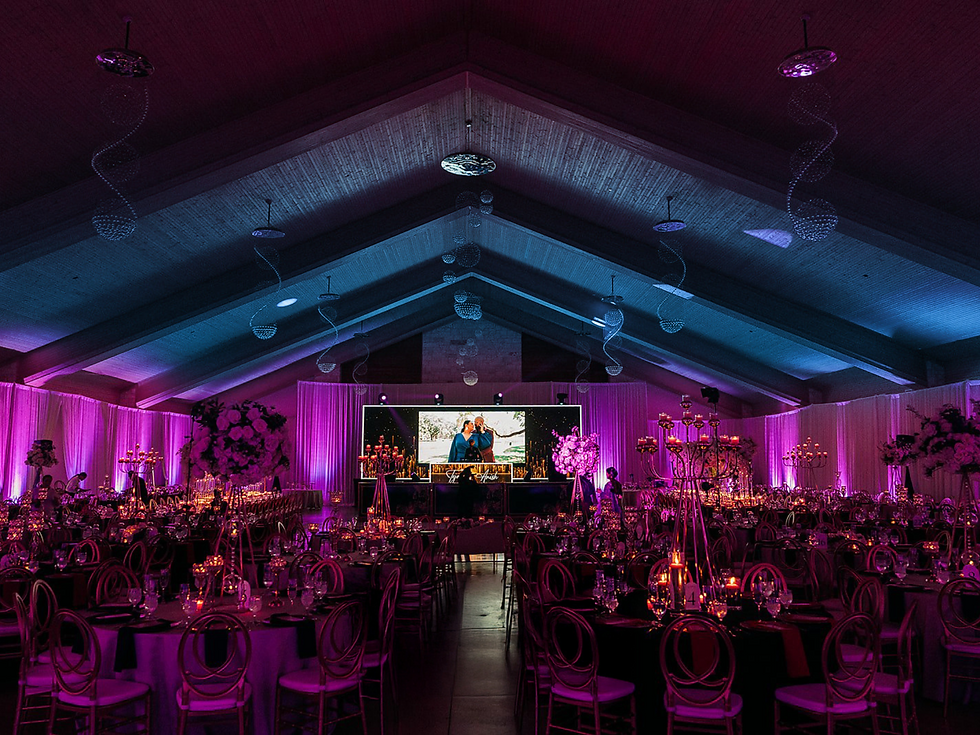
Uplighting: The Venue Transformer
What It Is: LED lights placed around your venue's perimeter, shooting light up walls to create colored washes.
What It Actually Does:
Completely changes your venue's color scheme
Makes spaces feel 2x larger
Hides ugly walls, exit signs, and architectural sins
Creates that "magazine wedding" look in photos
Real Example: At the Millwick in Downtown LA, we used 24 amber uplights to transform their industrial brick walls into what looked like a Tuscan villa at sunset. The photographer literally asked if we'd painted the walls.
When You Need It: ALWAYS. If you only get one lighting element, this is it. It's the difference between "nice wedding" and "holy crap, this is gorgeous."
Dance Floor Lighting: The Party Maker
What It Is: Intelligent moving lights, LED washes, and effects positioned around your dance floor.
What It Actually Does:
Creates energy that makes people want to dance
Provides those epic party photos with light beams
Synchronizes with music for concert-like experience
Makes your DJ setup look professional AF
Real Example: At a recent Terranea Resort wedding, our moving heads synced with the beat drop during "Mr. Brightside." 200 guests simultaneously lost their minds. The video has 50K views on TikTok.
When You Need It: If dancing is important to you (and it should be), you need real dance floor lighting. Those two colored par cans your DJ brings for free? That's not it.
Pin Spotting: The Detail Highlighter
What It Is: Focused beam lights that highlight specific elements.
What It Actually Does:
Makes centerpieces POP from across the room
Highlights your cake like it's in a jewelry store
Creates dramatic shadows and depth
Makes your photo booth area look intentional
Real Example: For a wine-themed wedding in Napa, we pin-spotted each table's wine bottle centerpiece. In the darkened room, it looked like 20 floating bottles of liquid gold. Pinterest lost its mind.
When You Need It: When you've invested in beautiful details that deserve to be seen. Why spend thousands on flowers if they disappear in darkness?

Gobo Projection: The Personalizer
What It Is: Custom templates that project patterns, monograms, or designs.
What It Actually Does:
Projects your monogram on the dance floor or wall
Creates texture (leaves, stars, patterns) on blank surfaces
Adds architectural interest to boring spaces
Makes your wedding feel custom-designed
Real Example: At a San Francisco City Hall wedding, we projected an art deco pattern that matched the building's architecture onto the tent ceiling. Guests thought it was a permanent installation.
When You Need It: When you want that "extra" factor that makes your wedding feel expensive and thoughtful.

String/Bistro Lighting: The Ambiance Creator
What It Is: Those Instagram-famous string lights everyone loves.
What It Actually Does:
Creates instant warmth and intimacy
Defines spaces (dance floor, lounge areas, bars)
Provides functional lighting that's also beautiful
Works indoors and outdoors
Real Example: At a Malibu beach wedding, we created a "ceiling" of bistro lights over the entire reception area. It felt like dining under stars, but with perfect lighting for photos.
When You Need It: Outdoor weddings, warehouse venues, or anywhere that needs warmth.
Specialty Effects: The Wow Factors
What Options Exist:
CO2 cannons for explosive moments
Fog machines for the first dance drama
Laser shows for late-night energy
LED wristbands for crowd participation
Sparkler machines for send-offs
Real Example: For a Nashville music industry wedding, we synchronized CO2 blasts with the horn section during "September." The combination of white blasts, gold lighting, and live horns created a moment so epic, three guests got engaged within the next month. True story.
When You Need It: When you want those viral moments that separate good weddings from legendary ones.
Real Venue Transformations That'll Make You Scream
Let's stop talking theory and show you actual transformations from our recent weddings. These are real venues, real budgets, and real results.
The "Boring Ballroom" Miracle (Beverly Hills Hotel, May 2024)
The Challenge: Classic hotel ballroom. Beige everything. Fluorescent lighting. Looked like a conference room.
The Lighting Design:
30 uplights in blush pink
Pin spots on all 20 tables
Custom monogram gobo on dance floor
Intelligent moving lights for dancing
Warm amber wash for dinner
The Result: Looked like a completely different venue. The hotel's event coordinator asked us for our card because she'd never seen their ballroom look that good.
The "Empty Warehouse" Transformation (Arts District LA, August 2024)
The Challenge: 10,000 sq ft of concrete. No built-in lighting. Looked like a storage facility.
The Lighting Design:
40 uplights creating color zones
200 feet of bistro lighting creating ceiling
Moving heads creating architectural interest
Custom gobo patterns on walls
Special effects for dramatic moments
The Result: Guests walked in and gasped. Literally. The raw space became an underground club meets secret garden. The venue now shows our photos to potential clients.
The "Outdoor Disaster" Save (Private Estate, Montecito, June 2024)
The Challenge: Beautiful property. Zero lighting infrastructure. Reception after sunset.
The Lighting Design:
Battery-powered uplights (no cables to trip on)
String lights creating reception perimeter
LED furniture for cocktail hour
Follow spot for speeches and first dance
Dance floor lighting on portable truss
The Result: Better than any indoor venue. The property owner hired us for their own daughter's wedding based on what they saw.
The "Budget-Conscious" Beauty (San Diego Community Center, March 2024)
The Challenge: Limited budget. Genuinely ugly space. Needed maximum impact for minimum investment.
The Lighting Design:
16 uplights (minimum for transformation)
DIY string lights (we consulted on placement)
Two moving heads for dance floor
Single gobo with couple's monogram
The Result: Total transformation for less than what some couples spend on their cake. Proof that lighting doesn't have to break the bank to break the internet.
Outdoor Wedding DJ Setup: Conquering Mother Nature
Outdoor weddings are gorgeous in theory and terrifying in practice. After handling hundreds of outdoor celebrations, here's your survival guide for outdoor wedding DJ setup and lighting.
The Power Problem
Outdoor venues rarely have enough power. That gorgeous vineyard? It's running on the same electrical system from 1952. Here's what actually works:
Generator Power: Quiet ones. Not the construction site kind that sounds like a helicopter. Professional wedding generators run at conversation level.
Battery-Powered Options: Modern LED uplights run 20+ hours on battery. No cables, no trip hazards, no power needs.
Power Distribution: Professional distro boxes that won't trip breakers when the photo booth, DJ, and lighting all hit peak load during "Sweet Caroline."
Weather-Proofing Your Setup
Wind: Weighted bases for everything. We've seen amateur setups become projectiles. Not cute.
Rain: Weather-resistant connections and covered control positions. Your DJ's equipment is expensive and allergic to water.
Heat: LED lights don't add heat like old-school lighting. Your August wedding guests will thank you.
Cold: Equipment needs time to acclimate. Bringing gear from a 70-degree truck into a 30-degree venue can cause condensation disasters.
Creating Ambiance Without Walls
Define Your Space: Use lighting to create "walls" and boundaries. String lights for perimeter, uplights on trees, gobos on the ground.
Layer Your Lighting: Ground lights, eye-level lights, and overhead elements. Creates depth that flat outdoor spaces lack.
Work With Nature: Uplight those beautiful oak trees. Wrap string lights around natural features. Make the outdoors part of your design, not something to overcome.
Have Backup Plans: Second setup location for wind. Tent lighting if weather forces you under cover. Battery power if generators fail.
The Perfect Timeline: When Each Lighting Element Matters
Your lighting needs change dramatically throughout your wedding day. Here's exactly when each element matters most, based on thousands of real events:
Ceremony (4:00-4:30 PM)
Natural light is your friend: Minimal lighting needed Exception: Winter weddings need subtle fill light by 4 PM Pro tip: Have uplights ready but OFF during ceremony. Nobody needs pink walls while saying vows.
Cocktail Hour (4:30-6:00 PM)
Transition time: Sun setting, energy building Essential: String lights create defined space Nice to have: Subtle uplighting beginning at 50% intensity Game changer: LED furniture for Instagram moments
Dinner (6:00-8:00 PM)
Peak lighting importance: This is when transformation happens Essential: Full uplighting, pin spots on tables Nice to have: Gobo projection, amber dinner wash Game changer: Lighting that dims during speeches for focus
First Dance (8:00 PM)
The movie moment: All eyes on you Essential: Follow spot or focused lighting on couple Nice to have: Fog machine for ethereal effect Game changer: Color change that matches your song's mood
Dancing (8:00 PM-Midnight)
Party mode activated: Energy through light Essential: Moving heads, dance floor wash Nice to have: CO2 cannons, laser effects Game changer: Lights that sync to beat drops
Last Dance (11:45 PM)
The finale: Send them home with a moment Essential: All lights on for group visibility Nice to have: Sparkler machines for exit Game changer: LED wristbands that pulse together

Lighting + Other Services: The Multiplication Effect
Here's where things get really interesting. Lighting doesn't just make your venue look better—it amplifies every other service you've hired. It's like Instagram filters for your entire wedding.
Lighting + DJ: The Power Couple
Your DJ services are only as good as they look and feel. Here's what happens when you combine pro DJ with pro lighting:
Visual Energy: Lights that pulse with bass drops create visceral reactions
Crowd Control: Lighting changes signal transition moments
Professional Appearance: Proper setup looks like a concert, not a school dance
Photo Opportunities: Every guest photo has professional lighting
Real Example: At a recent Four Seasons wedding, our DJ dropped "Levitating" while our lights created a constellation effect on the ceiling. The crowd reaction video went viral on the couple's hashtag.
Lighting + Photo Booth: The Content Creator
Your photo booth becomes a content studio with proper lighting:
Better Photos: Professional lighting = everyone looks amazing
Defined Space: Lighting creates an obvious "photo zone"
Brand Consistency: Booth lighting matches reception aesthetic
Extended Use: Good lighting keeps booth busy all night
Real Example: We created a "paparazzi alley" with sequential strobe lights leading to the photo booth. Guests felt like celebrities. The booth never had a break.
Lighting + Live Music: The Concert Experience
When you add live musicians with proper lighting:
Performance Space: Musicians become focal point
Dramatic Moments: Spotlight for saxophone solos
Energy Building: Lights intensity matches musical crescendos
Professional Feel: Looks intentional, not amateur
Real Example: Our violinist walked through the crowd during "Perfect" by Ed Sheeran, followed by a roving spotlight. There wasn't a dry eye. The videographer still uses it in their portfolio.
Lighting + Special Effects: The Viral Moment
Combining lighting with special effects creates those shareable moments:
Synchronized Impact: CO2 blasts with strobe lights
Layered Drama: Fog machines with colored uplighting
Safety First: Proper lighting for sparkler exits
Maximum Wow: Multiple effects hitting simultaneously
Real Example: Last NYE wedding: Countdown on gobo projection + CO2 blast at midnight + gold lighting + sparkler machines. It looked like Times Square. 300 guests, 300 phone videos.
DIY vs. Professional: The Truth Nobody Wants to Hear
Look, we get it. Weddings are expensive. You're looking at your budget thinking, "Can't we just buy some uplights on Amazon and call it a day?"
Sure. You can. But here's what actually happens:
The DIY Dream
What You Think: Save money, have control, how hard can it be?
The Reality:
Setup takes 6 hours instead of 2
Half the lights have different color temperatures
Nobody knows how to program DMX controllers
Your wedding party becomes your tech crew
Something WILL go wrong during your reception
The Hidden Costs of DIY
Equipment Rental/Purchase: Those uplights are $40 each. You need 20 minimum. That's $800.
Power and Cables: Extension cords, power strips, gaffer tape. Add $200.
Programming Time: Learning curve = 20 hours minimum. What's your time worth?
Day-Of Stress: Priceless. And not in a good way.
Backup Plan: When lights fail, then what? Professional backup = another $500.
Total "Savings": Maybe $500-1000, but at what cost to your sanity?
When DIY Makes Sense
Intimate weddings under 50 guests
Single lighting element (just string lights)
You have a friend who's ACTUALLY a lighting designer
Daytime receptions with minimal lighting needs
When You Need Professionals
Venues over 3,000 square feet
Multiple lighting elements needed
Outdoor weddings requiring power management
You want to actually enjoy your wedding
Photos matter to you (they should)
The Middle Ground
Can't afford full professional lighting but know DIY is risky? Here's the compromise:
Hire for Essentials: Get pro uplighting and dance floor lights. DIY the string lights.
Consultation Services: Some companies (like us) offer design consultation. We plan, you execute.
Partial Packages: Book just setup/breakdown. You provide equipment.
Venue Partnerships: Many venues have preferred lighting vendors with discounts.

Making Lighting Decisions That Don't Suck
After 6,000+ weddings, here's our no-BS framework for making lighting decisions:
Priority Level 1: Non-Negotiables
These create the most impact for your investment:
Uplighting (transforms any venue)
Dance floor lighting (creates party energy)
Basic DJ facade lighting (looks professional)
Get these three, and you're already ahead of 70% of weddings.
Priority Level 2: High Impact Additions
If budget allows, these take you from good to incredible:
Pin spotting (highlights details you paid for)
Gobo projection (personalization and texture)
String lighting (warmth and ambiance)
Priority Level 3: The Wow Factors
For couples who want their wedding to be THE wedding of the year:
Intelligent moving lights (concert vibes)
Special effects (viral moments)
Custom architectural lighting (magazine-worthy)
Questions to Ask Any Lighting Vendor
"Can we see photos of this exact venue with your lighting?" If they can't show you, they haven't done it.
"What's your backup plan for equipment failure?" The answer better not be "that never happens."
"Who's running lights during our event?" "It's automated" = nobody's watching when things go wrong.
"How much power do you need?" If they don't ask about your venue's power, run.
"Can you coordinate with our other vendors?" Lighting affects photography, videography, and DJ services. They better play nice.
Red Flags to Avoid
"We'll figure it out day-of" (No. Just no.)
Can't provide proof of insurance
No contract or unclear terms
Prices that seem too good to be true
No venue site visit offered
Bad reviews about setup/breakdown damage
FAQ: Every Lighting Question You're Afraid to Ask
Do we really need lighting if our venue is already beautiful?
Yes, absolutely—every venue needs professional lighting after dark, regardless of how stunning it looks during daytime tours. That gorgeous venue you fell in love with during your 2 PM Tuesday walkthrough transforms completely on Saturday night when natural light disappears and standard venue lighting creates harsh shadows and unflattering illumination. After 6,000+ weddings across every venue type from historic estates to luxury hotels to outdoor gardens, we've learned that even architecturally beautiful spaces look flat and uninspired at night without proper lighting design. Professional uplighting on walls and architectural features, strategic dance floor lighting that creates energy and movement, and thoughtfully placed accent lighting transform venues from basic event spaces into curated celebration environments. The investment in lighting often delivers the highest visual return of any décor element because it fundamentally changes how your entire venue looks and feels throughout your celebration, particularly during the critical evening hours when most of your reception happens.
What's the minimum lighting package to avoid looking cheap or basic?
The baseline for professional-looking wedding lighting includes 16 uplights strategically placed around your venue perimeter, basic dance floor lighting with at least two moving heads and wash lights, and facade lighting for your DJ booth so it integrates into your design rather than sitting as a black hole of equipment. This configuration transforms most venues under 5,000 square feet from looking like basic event spaces into polished celebration environments without crossing into excessive territory. Anything less than this minimum and you risk high school dance territory where inadequate lighting makes your carefully planned celebration feel amateur. We've worked thousands of weddings across Los Angeles, Orange County, San Francisco, and beyond where proper lighting transformed venues that looked ordinary during setup into spaces that guests genuinely complimented throughout the night. The difference between adequate lighting and insufficient lighting is immediately visible in both real-time guest experience and in your photos—your photographer will notice the difference even if you think you won't.
Can our friend who "does lighting" handle our wedding?
Does your friend have $50,000+ in professional equipment including DMX control systems, backup gear if primary fixtures fail, comprehensive liability insurance covering venue damage and guest injury, and specific experience working your venue or similar spaces? If you answered no to any of these questions, then no, your friend cannot handle your wedding lighting professionally. After working thousands of events, we've seen well-meaning friends with basic DJ equipment or photography lighting gear attempt wedding lighting and create disappointing results—wrong fixtures for the application, no backup when equipment fails, incompatibility with venue power systems, or simply not knowing how to design lighting that enhances celebration atmosphere. Your friend might have lighting equipment, but wedding lighting requires specific expertise in reading crowds and adjusting throughout the night, coordinating with venue constraints and requirements, managing power distribution and technical troubleshooting, and creating designs that photograph beautifully. Professional lighting isn't just about owning fixtures—it's about comprehensive systems and years of experience across diverse venues.
When should we book wedding lighting services?
Book lighting services simultaneously with your DJ services—typically 9-12 months out for peak season Saturday dates, especially at popular venues across California, Nashville, or other competitive markets. The best lighting designers and comprehensive entertainment companies book early, and many providers (including us) offer package deals when you book multiple services together rather than piecemealing vendors. Booking lighting early also allows proper planning—site visits to understand your venue's specific needs, coordination with your wedding planner or designer on color schemes and aesthetic vision, and equipment customization if your venue has unique requirements or challenging layouts. Last-minute lighting additions are sometimes possible with 2-4 weeks' notice, but you're limited to whatever equipment and design time remains available rather than getting customized solutions that maximize your venue's potential. After thousands of weddings where lighting transformed good celebrations into exceptional ones, we've learned that early planning delivers dramatically better results than rushed last-minute additions.
How do we know how many lights we need for our venue?
Use this rough formula as a starting point: one uplight per 150 square feet of wall space, so a 3,000 square foot venue needs approximately 20 uplights for full coverage. Pin spots for tables require one per centerpiece or table for dramatic highlighting—a 15-table reception needs 15 pin spots for complete coverage. Dance floor lighting requires minimum two moving heads plus wash lights for adequate energy and movement. However, these formulas provide baselines, not definitive answers—actual requirements depend on your venue's architecture and layout, ceiling height and architectural features, color scheme and design aesthetic, and specific atmosphere you want to create. After working hundreds of venues from intimate wine country estates to large hotel ballrooms across our markets, we've developed strong instincts for lighting design. We'll visit your venue or review floor plans to provide customized recommendations rather than generic package formulas that might not maximize your specific space's potential.
What about using candles instead of professional lighting?
Candles are beautiful decorative elements in photos but provide almost zero functional illumination for your celebration—use them for decoration, not lighting. In reality, a dozen candles on your tables create lovely ambiance in photographs but don't illuminate faces, don't light your dance floor, and don't transform your venue's architecture the way professional lighting does. Additionally, many venues across California and other states ban real flames entirely due to fire safety regulations, forcing you toward LED candles that provide even less actual light. Candles complement professional lighting beautifully, but they can't replace it. After thousands of weddings where couples relied too heavily on candles and ended up with dark, poorly lit receptions that looked disappointing in photos, we always recommend professional lighting as your foundation with candles as your enhancement. Your guests' faces, your dance floor energy, and your venue's architectural features all require actual light that candles simply cannot deliver at the scale your celebration demands.
Will professional lighting make our venue uncomfortably hot?
Modern LED lighting produces minimal heat compared to old-school incandescent or halogen fixtures that dominated wedding lighting a decade ago—your 200-person guest list will generate significantly more heat than our entire professional lighting rig. This is one of the primary reasons the wedding industry transitioned to LED technology—it delivers brilliant, customizable color and intensity without the heat output that made older lighting systems uncomfortable. We've worked outdoor summer weddings in Palm Springs and Palm Desert where temperatures exceed 100°F, and our LED lighting systems don't meaningfully contribute to guest discomfort. The heat concern was legitimate with older technology but is essentially irrelevant with modern professional LED fixtures. Your venue's HVAC capacity, guest density, and outdoor temperature (if applicable) will determine comfort far more than professional lighting ever could. After thousands of events across every climate condition, we can confidently say that lighting heat is not a legitimate concern with contemporary professional equipment.
Can professional lighting really make that much difference in wedding photos?
Your photographer will literally thank you—good lighting is the difference between everyone looking amazing in your photos and everyone looking like they're in witness protection with harsh shadows and unflattering illumination. Professional photographers consistently cite lighting as the most important factor in reception photo quality, often more important than their camera equipment or settings. Proper uplighting eliminates harsh shadows on faces, dance floor lighting adds energy and movement to celebration photos without creating unflattering direct flash, and strategic accent lighting creates depth and dimension that makes photos look professional rather than snapshot-quality. After 6,000+ weddings where we've worked alongside California's top wedding photographers from Los Angeles to San Francisco, we've seen how dramatically lighting quality affects photo outcomes. Photographers often specifically request to work with professional lighting companies because it makes their job easier and results better. Ask any professional wedding photographer about the importance of reception lighting and they'll confirm it's non-negotiable for beautiful photos—your photo investment deserves lighting that maximizes those results.
What if our venue has lighting restrictions or limitations?
Most venues have some restrictions—no open flames, no fog machines, no attachments directly to walls or ceilings, no equipment blocking emergency exits. Professional lighting companies navigate these restrictions daily and have solutions that comply with every venue's specific requirements. We've worked hundreds of venues across California, Tennessee, Florida, and destination locations, each with unique rules about equipment placement, power consumption, load-in timing, and technical specifications. Some historic venues prohibit any wall attachments, requiring specialized stands and weighted bases. Outdoor venues might restrict power consumption or require generator solutions. Venues with strict aesthetic requirements might limit visible equipment or require specific placement. Our experience means we've likely worked your venue before or handled similar restrictions elsewhere, so we know what questions to ask venue management and what solutions work within their constraints. Restrictions don't prevent professional lighting—they just require experienced professionals who know how to work within guidelines.
Is colored lighting tacky or outdated for weddings?
Bad colored lighting is absolutely tacky—we're looking at you, cheap RGB strip lights from Amazon creating rainbow disco effects that scream 1990s prom. However, professional color design that complements your wedding palette, changes appropriately throughout the night as energy builds, and uses sophisticated fixtures creating nuanced color blends rather than harsh single-color washes is magazine-worthy and elevates your entire celebration aesthetic. The difference is equipment quality, design expertise, and appropriate application. We might use soft amber and blush tones during dinner that complement your floral palette, transition to more saturated colors as dancing begins and energy builds, and adjust throughout the night based on crowd response and celebration atmosphere. After thousands of weddings across every style from classic elegant to modern bold, we've learned that thoughtful color design enhances your vision while poor color choices or cheap equipment undermines even the most expensive décor. Trust professionals who understand color theory, appropriate application, and how lighting design integrates into overall wedding aesthetics rather than thinking all colored lighting is created equal.
The Bottom Line: Lighting Is Your Secret Weapon
Here's what 6,000+ weddings have taught us: Couples remember two things about weddings they attend—the food and the atmosphere. You can't control if Aunt Karen likes the salmon, but you can absolutely control whether your wedding feels magical or mundane.
Lighting is the difference between:
iPhone photos that look professional vs. everyone looking like ghosts
A dance floor that's packed vs. people leaving after dinner
A venue that feels expensive vs. one that feels like a conference room
Moments that go viral vs. moments nobody remembers
Feeling like you're at a WEDDING vs. feeling like you're at... an event
We've seen couples spend $5,000 on flowers that nobody remembers but skip $2,000 on lighting that would've transformed everything. We've watched receptions die because the only lighting was overhead fluorescents. We've also seen "budget" weddings become legendary because they invested in proper lighting that made their American Legion hall look like a European castle.
Your wedding is theater. Your guests are the audience. And theater without lighting? That's just people talking in the dark.
The couples who "get it" don't ask "Do we need lighting?" They ask "How do we make our lighting unforgettable?" Because they understand that lighting isn't a line item—it's the multiplier that makes every other investment shine (literally).
So whether you're planning an intimate Santa Barbara estate wedding or a massive Las Vegas production, whether you've got champagne dreams or beer budget realities, remember this:
Good lighting makes good weddings great. Great lighting makes great weddings legendary.
And legendary? That's what you're after, isn't it?
Ready to transform your venue from ordinary to extraordinary? Contact our team to explore lighting options that fit your vision and venue. From subtle elegance to full production, we've lit every kind of celebration imaginable. And yes, we can make your venue look like that Pinterest board you've been obsessing over.
Want more insider tips? Check out our guide on choosing the perfect DJ services or discover why photo booths and lighting are the ultimate power couple for guest entertainment.


